You want to make mole at home. Not the jarred stuff that tastes like chocolate syrup thinned with ketchup — the real thing, the kind that stains your wooden spoon and makes your kitchen smell like a market in Puebla for two days afterward. Here's the honest truth before you start: mole is not a recipe, it's a project. The first time I made mole poblano from scratch, I burned the chiles so badly that my smoke alarm went off twice and my neighbor knocked on the door to ask if everything was okay. The sauce still came out decent. Barely. But I learned more from that disaster than from any perfectly curated recipe I followed afterward.
So let's talk about what authentic mole actually demands — the ingredients that matter, the substitutions that don't ruin everything, and the mistakes I made so you don't have to repeat them.
Key Takeaways
- Authentic mole poblano traditionally uses over 20 ingredients, including dried chiles, nuts, seeds, spices, and bitter chocolate
- Toasting is the most dangerous step — burned chiles turn the entire sauce bitter and there's no rescuing it
- You do not need a molcajete or a traditional stone grinder; a blender and patience work fine
- Mole negro from Oaxaca is the hardest variety to master; start with poblano or coloradito
- Good mole takes 3 to 6 hours, but most of that is hands-off simmering
- Outside Mexico, ingredient substitutions are normal — authenticity lives in the technique, not the exact chile list
What makes a mole sauce authentic, and why most home cooks get it wrong
Mole comes from the Nahuatl word mulli, which simply means "sauce." That's the first thing to understand: mole isn't one dish. It's a family of sauces, and each region of Mexico has its own version with different chiles, different thickeners, different levels of sweetness. Puebla claims mole poblano. Oaxaca is famous for mole negro. Veracruz has its own variations.
The mistake I see most often — and I made it myself for months — is treating mole like a chocolate sauce. It isn't. Chocolate is a background note, often less than 5% of the total volume. The backbone is dried chiles, and if you taste chocolate first, something went wrong in the balance.
Why the ingredient count actually matters
You'll see "23 ingredients" or "30 ingredients" quoted everywhere. That number isn't a rule — it's a symptom of how mole works. Each ingredient contributes a layer: chiles bring heat and fruitiness, nuts and seeds bring body and fat, spices bring aroma, chocolate and fruit bring sweetness and acidity. Strip out too many layers and you get a flat sauce that tastes like spiced tomato paste.
That said, you don't need all 30. My current version uses 17 ingredients and I've served it to Mexican friends who asked for the recipe. The layers that matter most:
- Dried chiles — at minimum three varieties (more on this below)
- Nuts and seeds — almonds, peanuts, sesame, pumpkin seeds
- Spices — cinnamon, cloves, black pepper, anise
- Bitter chocolate — Mexican chocolate or dark chocolate above 70%
- Acid and sweetness — tomato, tomatillo, raisins, or piloncillo
- Fat — lard traditionally, but a neutral oil works
Everything else is seasoning. Once you understand the role each layer plays, you can improvise without losing the soul of the dish.
The second mistake is rushing the fry. Traditional mole recipes call for frying each ingredient group separately — chiles, then nuts, then seeds, then spices — before grinding. Skipping this step saves 20 minutes and costs you the entire depth of flavor. I tried skipping it once out of laziness. The sauce tasted thin, like a smoothie someone forgot to finish. Never again.
What are the ingredients in a traditional mole sauce?
A traditional mole sauce, particularly mole poblano, contains dried chiles, nuts, seeds, spices, chocolate, and often fruit or tomato. The specific chiles vary enormously by region, but the most common combination in Puebla-style mole is:

- Ancho chiles — dark, raisiny, mild heat
- Pasilla chiles — long, wrinkled, herbal
- Mulato chiles — smoky, with a hint of licorice
- Chipotle (sometimes) — adds smokiness and heat
Beyond chiles, you'll find toasted almonds or peanuts, sesame seeds, pumpkin seeds, cinnamon (preferably Ceylon), cloves, black peppercorns, anise, coriander seed, garlic, onion, tomato or tomatillo, raisins, and a small amount of bitter chocolate. Some recipes add stale bread or tortilla as a thickener.
Here's what nobody tells you: the chile blend is 80% of the flavor profile. If you only get three chiles right, you can fudge the rest. If you get the chiles wrong, no amount of chocolate will save you.
Which chiles to buy when you're not in Mexico
This is the question I get most often, and it's the one where most guides go silent. If you're shopping outside Mexico, you'll see ancho, pasilla, and chipotle easily at most Latin American groceries or online spice shops. Mulato is harder. Negro and chihuacle negro — the Oaxacan varieties for mole negro — are nearly impossible unless you order from a specialist importer.
My substitution strategy, tested across dozens of batches:
| Original chile | Best substitute | Effect on flavor |
|---|---|---|
| Mulato | Ancho + a pinch of smoked paprika | Nearly identical; adds smoke |
| Chihuacle negro | Pasilla + chipotle (small amount) | Less fruity, more smoky |
| Chipotle meco | Chipotle morita | Less intense heat, more sweetness |
| Pasilla mixe | Pasilla + dried guajillo | Different heat level, similar depth |
Is it identical? No. Is it delicious and worth making? Yes, absolutely. Authenticity in cooking has more to do with honoring the technique than with matching a list of regional ingredients you can't access.
How do I make my own mole sauce?
Here's the process I use, refined over years of trial, error, and one memorable kitchen fire.
Step 1: toast the chiles — carefully
Stem and seed your chiles. Heat a dry skillet over medium heat and press each chile flat for 10 to 20 seconds per side. You want them pliable and fragrant, not blackened. The moment they smell toasted, get them out. Burned chile is bitter beyond saving — this is where my first attempt failed.
Step 2: fry each ingredient group separately
In a little lard or neutral oil, fry the chiles until they soften, then set aside. Do the same with the nuts, then the seeds, then the spices (30 seconds max for spices). Separating the groups keeps each one from overpowering the others.
Step 3: grind and simmer
Blend in batches with chicken broth until you have a thick, smooth paste. Fry the whole paste in a heavy pot for about 10 minutes — this step, called freír el mole, is what develops the color and depth. Add more broth until you reach the consistency of warm pudding. Simmer, partially covered, for at least 90 minutes, stirring every 15 minutes to prevent scorching.
If the sauce looks grainy, blend again after cooling. If it's too thick, add broth. If it's bland, add salt — usually more than you think, since chiles absorb a lot.
Is mole sauce authentic Mexican?
Yes, unambiguously. Mole predates the Spanish arrival — evidence of chile-and-seed sauces goes back centuries in pre-Hispanic Mexico, and the modern mole poblano emerged in Puebla's convents sometime in the colonial era. Today it's a national dish, served at weddings, holidays, and family gatherings across the country.
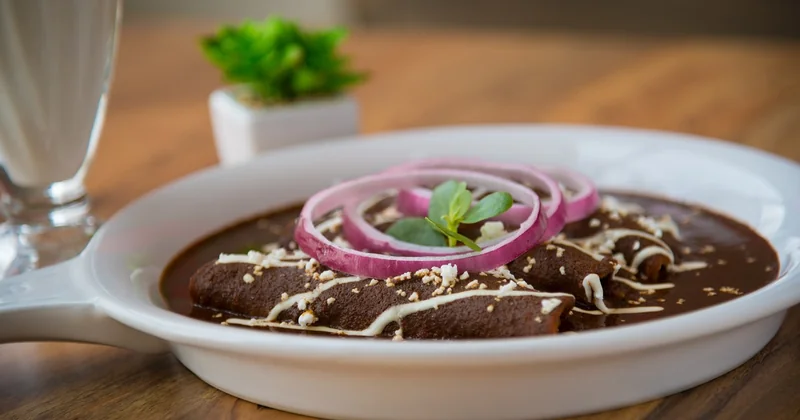
The version you find in most American or European restaurants is often a simplified chocolate-forward sauce rather than the layered, chile-dominant original. That doesn't make it inauthentic — it makes it adapted. Mexican cooks themselves adapt mole constantly. The tradition is alive, not frozen.
What are the 7 different types of mole sauce?
There are actually more than seven, but the most recognized varieties are:
- Mole poblano — from Puebla; dark, complex, mildly sweet
- Mole negro — Oaxacan; the darkest, most bitter, uses charred ingredients
- Mole verde — green, made with tomatillos and fresh herbs (not dried chiles)
- Mole coloradito — reddish, milder, easier for beginners
- Mole manchamanteles — "tablecloth stainer"; fruity, often with pineapple
- Mole amarillo — yellow, from Oaxaca, lighter and tangier
- Mole rojo — varies by region; simpler tomato-and-chile base
For a first attempt, mole coloradito is the friendliest — fewer ingredients, shorter cook time, less risk of bitterness. Mole negro is the mountain peak; climb it after you've done a couple of poblano batches.
Is mole sauce spicy?
Less than you'd expect. The dried chiles used in mole — ancho, pasilla, mulato — are mild to medium, and toasting plus blending tames their heat considerably. Most mole poblano lands somewhere around a gentle warmth, more aromatic than fiery. Mole negro can be slightly hotter, but still far below a good salsa.
The heat you feel depends on the chipotle ratio. If you want more kick, add a second chipotle. If you'd rather avoid heat entirely, skip it — the sauce survives without it.
The mole you make badly is still better than the mole you don't make
My third batch — after the smoke alarm incident — was the first one I was genuinely proud of. It took four hours and I burned myself twice, but my kitchen smelled like Puebla for two days and I understood, for the first time, why Mexican families pass mole recipes down like heirlooms.
The sauce you make at home won't be identical to what you'd eat in a Puebla market. It shouldn't be. That version belongs to that place. Yours will be the one your neighbors ask about, the one that starts with a slightly different chile because the store only had ancho, the one that becomes yours.
So pick a day with nothing else scheduled. Buy more chiles than you need. Keep a glass of water nearby for the heat, but more importantly, keep your patience — mole rewards it in ways few dishes do.