Someone once asked me to help them unpack after a move into a 38-square-metre flat. The kitchen had two drawers, one metre of counter, and a hob with two rings. They had brought eleven spatulas. Not a typo — eleven. We ended up keeping two and they never once mentioned the missing nine.
That afternoon is the reason I now think about essential kitchen tools for a minimalist kitchen as a filtering problem rather than a shopping problem. You are not building a collection. You are deciding what earns the cost of being washed, stored, and moved. Get that decision right and the kitchen stops fighting you.
Key takeaways
- A minimalist kitchen is defined by use frequency, not by how few items you own.
- Roughly a dozen tools cover the overwhelming majority of everyday cooking.
- One good knife beats four mediocre ones. Sharpen it and you are done.
- Anything that does only one job and does it rarely should go.
- Consumables — sharpening, good oil, decent storage — matter more than gadgets.
- Your cooking style changes the list. Batch cooking and pastry add a couple of extras, not a drawerful.
The 10 essential kitchen tools that actually earn their place
What are the 10 essential kitchen tools? A chef's knife, a cutting board, a large sauté pan, a saucepan, a wooden spoon, tongs, a spatula, a mixing bowl, a colander, and a set of measuring cups or a scale. Ten items, one small drawer, no compromise on the food you can cook.
I want to be honest about how I got to that number. My first attempt was a spreadsheet with 47 rows. I rated each item on how often I used it, and after two months of honest tallying, the results were almost embarrassing: twelve items covered more than 90% of what I actually cooked. The rest were emotional purchases.
Why ten and not twenty
The number is not sacred. It is a stake in the ground. What matters is that you have a defensible ceiling, because without one, the drawer fills itself. And the ceiling should come from your cooking, not from a blog post — including this one.
Below is the list I actually keep. Note that the third column is where the real decision gets made.
| Tool | Frequency in my kitchen | What it replaces |
|---|---|---|
| 20 cm chef's knife | Daily | Paring, bread, and utility knives |
| End-grain cutting board | Daily | Three plastic boards |
| 28 cm sauté pan with lid | 5–6×/week | Frying pan, wok, shallow pot |
| 2 L saucepan | 4×/week | Stockpot, rice cooker, milk pan |
| Wooden spoon | Daily | Silicone spoon, ladle, stirrer |
| Stainless tongs | 5×/week | Turner, salad servers, pasta fork |
| Flexible spatula | 4×/week | Bowl scraper, cake spatula |
| Large mixing bowl | 3×/week | Colander, salad bowl, proofing bowl |
| Colander | 3×/week | Steamer insert, sieve |
| Kitchen scale | 3×/week | Measuring cups, portion guesswork |
The honest test for each row: if you removed it, would you cook something different tomorrow? If the answer is no, it is decoration.
What are some good minimalist kitchen utensils?
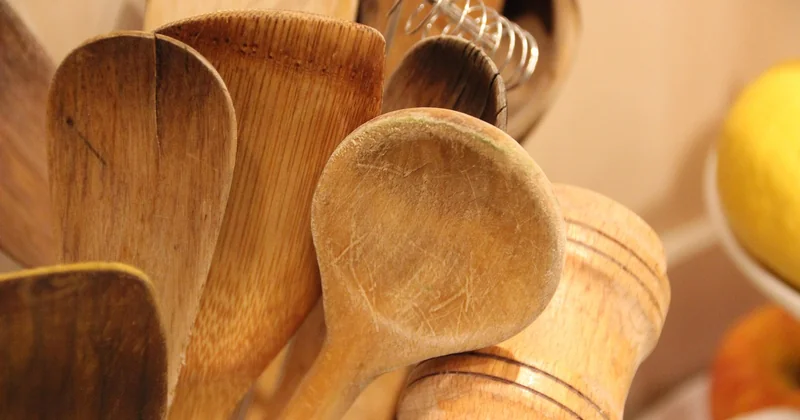
Good minimalist utensils share three traits: they are single-piece (no silicone heads that trap water and eventually split), they nest or hang without a holder, and they do not pretend to be three tools. Stainless tongs, a wooden spoon, a flexible spatula, and one sturdy pair of scissors will get you through the vast majority of tasks.
The multi-tool list
Some utensils genuinely do more than one job. I have had the same stainless tongs for years and I use them to turn meat, toss salad, lift pasta out of water, and pull toast from a hot slot. That is four tools collapsed into one object.
- Stainless tongs — turner, pasta fork, salad servers, toast retriever.
- Flexible silicone spatula — bowl scraping, folding, pan scraping, cake release.
- Wooden spoon — stirring, tasting, breaking up mince, and it will not scratch anything.
- Kitchen scissors — snipping herbs, cutting chicken, opening packaging, and trimming vegetables faster than a board.
- Microplane or fine grater — zesting, garlic, parmesan, ginger. One small object, five jobs.
Notice the asymmetry in that list. A spatula costs little and does a lot; an avocado slicer costs the same and does exactly one thing, badly, for six weeks a year. Value is not price. Value is use divided by storage.
What to skip, and why it is harder than it looks
Skip anything whose job is a single ingredient. Avocado slicers, strawberry hullers, garlic peelers, banana slicers. Then skip the duplicates: the second whisk, the small pan you keep for eggs, the blender you use twice a year.
Here is the uncomfortable part. I bought a mandoline to make one specific salad. I used it four times, cut myself once, and gave it away. That is a small failure but a useful one: it taught me that the real cost of a gadget is not the money, it is the permission it gives you to keep buying.
What are the essential kitchen tools everyone needs?
The universal core is a sharp knife, a board, one pan, one pot, and something to stir with. Everything beyond that depends on what you actually cook. A person who makes soup every week needs a pot that person who grills fish daily does not. Start from your own plate, not from a list.
A decision method you can reproduce
I use a three-question filter on every item in the drawer. It takes about twenty minutes for the whole kitchen and it settles arguments with yourself.
- Have I used this in the last 30 days? If no, it goes in a box.
- If it went in the box, would I miss it in the next 30 days? If no, it leaves the house.
- Could one existing tool do this job at 80% as well? If yes, the existing tool wins.
The box is important. Throwing things out immediately triggers regret and re-purchase. A box on top of a cupboard is a low-stakes trial. In my case, four of the items I boxed came back out within a week — a citrus reamer, which I genuinely use more than I thought. The other nineteen did not, and I do not miss them.
Materials: what actually lasts
Wood, stainless steel, and cast iron age well and can be repaired. Cheap non-stick coating does not: it degrades, and once it starts flaking the pan is finished. I have replaced three non-stick pans in as many years, and one stainless pan has outlasted all of them.
This is where the minimalist case pays for itself. Fewer, better items is not austerity. It is a lower total spend over a decade, and a kitchen you can clean in five minutes.
What are 20 essential kitchen tools — and why you probably need fewer
You can get to twenty by adding a sheet pan, a grater, a whisk, a garlic press, a peeler, a slotted spoon, a ladle, a set of airtight containers, a can opener, and a dish rack. That is a reasonable list for a household that cooks from scratch most days. It is also a list that fails the 30-day test for a lot of people.
The gap between ten and twenty is where minimalism gets tested. Someone will tell you that you cannot cook without a garlic press. You can — a knife and a pinch of salt do the same job in about fifteen seconds.
Where the twenty-item list makes sense
Two situations justify the longer list. First, a household cooking for four or more most days, where volume changes how tools are used. Second, anyone doing regular batch cooking: extra containers, a bigger pot, and a second sheet pan earn their place through repetition, not aspiration.
For everyone else, the extra ten items mostly occupy space. I would rather spend that space on a clean counter, which I have found does more for my cooking than any single gadget. This is the unglamorous truth of a minimalist kitchen: the counter is the tool.
The moving-in shortcut
If you are setting up a kitchen from zero, buy in two waves. Wave one is the ten items above. Wave two is whatever you found yourself improvising during the first month.
That improvisation signal is the most reliable data you will ever get, because it is measured rather than imagined. Buy only what the first month asks for. It is slower than a shopping spree and far cheaper.
The question I get asked most
People usually want to know the budget. My answer is that the money goes to the knife and the pan, and almost nothing else. Sharpening the knife matters more than its price. A cheap knife kept sharp will outperform an expensive one that has gone dull — that is not an opinion, it is just how cutting works.
So: one knife, one stone or a local sharpener, one pan, one pot, one board. The rest is detail. If you get those five right, the eleven spatulas problem solves itself, and you will not miss a single one of them.