You already own a good knife. So why does dicing an onion still take you four minutes and leave you with a pile of uneven chunks?
Here's the thing: a sharp knife is only half the equation. The other half is what your hands do with it. I learned this the hard way when a chef friend watched me prep dinner one evening and said, mildly, "You're cutting like you're afraid of the board." He was right. I was gripping the handle like a hammer and hacking at vegetables from a safe distance.
That night he showed me three adjustments—nothing exotic, nothing that required buying anything—and my prep time for a simple mirepoix dropped from roughly eight minutes to under four. Same knife. Same cutting board. Different knife skills.
What follows is the working set of techniques and habits I now consider non-negotiable for anyone cooking at home, plus the specific mistakes I made so you can skip them.
Key Takeaways
- The pinch grip and the claw are the two foundation skills—everything else builds on them.
- Five cuts cover roughly 90% of home cooking: rough chop, slice, dice, julienne, chiffonade.
- A sharp knife is safer than a dull one. A dull blade skids; a sharp one bites where you aim it.
- You need four knives, not seven. A chef's knife does most of the work.
- Practice on onions and carrots, not on expensive ingredients. Onions forgive, and they teach you the rocking motion.
- Speed is the last thing to arrive and the least important. Consistency first, always.
What are the 5 basic knife skills every home cook should learn?
The five foundational skills are the pinch grip, the claw, the rock chop, the slice (including the draw cut), and the dice. Everything else in a cookbook's technique section is a variation on these.
Notice what's missing from that list: nothing about specific vegetable shapes. The shapes are downstream. Get the grip and the guiding hand right and julienne becomes a matter of geometry rather than a separate skill to memorize.
The pinch grip: why you should stop holding the handle
Hold the blade between your thumb and index finger, right where the blade meets the bolster, and wrap the remaining three fingers around the handle. Your index finger and thumb are now on the steel itself, controlling the angle directly.
The first time I tried this, it felt absurd—like holding a pencil by the wrong end. It stayed awkward for about a week. Then something clicked, and I noticed I could feel the blade's angle against the board in a way I never could with a handle grip. Control moved from my wrist to my fingertips.
Try it for one full prep session. If it still feels wrong after that, you may be gripping too far forward—slide your fingers back until the blade feels balanced rather than tippy.
The claw: your knuckles are the guide
Curl the fingertips of your guiding hand under so your knuckles face the blade, thumb tucked behind. The knife's flat side rides against your knuckles as you cut. Your fingertips stay out of the path entirely, and the knuckle acts as a depth gauge, spacing each slice automatically.
This is the single change that made me stop fearing my own knife. Before the claw, every cut carried a small current of anxiety. After it, I could look at the onion instead of at my fingers.
The cuts worth mastering (and the ones you can skip)
Cookbooks list a dozen named cuts. You can ignore most of them.
| Cut | What it produces | Where it earns its keep |
|---|---|---|
| Rough chop | Irregular 2–3 cm pieces | Stocks, soups you'll blend, roasting trays |
| Slice | Even flat pieces | Stir-fries, gratins, sandwiches |
| Dice | Uniform cubes, 1 cm or smaller | Mirepoix, salsas, anything that needs even cooking |
| Julienne | Matchsticks, roughly 3 mm thick | Slaws, garnishes, quick vegetable sautés |
| Chiffonade | Fine ribbons | Basil, mint, leafy greens |
The named fine cuts—brunoise, fine julienne—matter if you're plating for guests. For a Tuesday dinner, they're theatre. I spent an embarrassing amount of time chasing a perfect brunoise early on, and the only thing it improved was how long my carrots took to cook.
One cut that doesn't get enough attention: the draw cut
For anything soft and delicate—a ripe tomato, a piece of fish, a mushroom—stop pushing straight down. Place the heel of the blade at the far edge and draw it back toward you in one smooth motion, using the whole length of the edge. The blade slices through rather than crushing. It's also the move that saves fragile herbs from turning to mush.
What are some important knife skills for cooking that recipes never mention?
Three of the most useful skills aren't cutting techniques at all. They're about the setup.
- Board stability. Put a damp kitchen towel under your cutting board. A board that shifts mid-cut is how people nick themselves, and it's a two-second fix.
- Board height relative to your body. Your cutting surface should sit roughly level with your lower ribs. Too low and you'll round your shoulders and lose control; too high and you'll cut at a slant. A thick board on a low counter is often worth more than a new knife.
- Edge maintenance as a habit. Ten seconds of honing before each session, sharpening every four to six weeks of regular use. I ignored this for a year and couldn't understand why my slicing got sloppy—it wasn't me, it was a dull edge.
And the practical one: cut ingredients in the order the recipe needs them, but prepped by cooking time. Onions first if they hit the pan first. That sequencing alone cleaned up my counter workflow more than any technique.
How do you practice knife skills without wasting food?
Onions. Carrots. Potatoes. That's the whole answer.
Onions are cheap, they're unstable enough to teach you the claw properly, and the layers give you instant visual feedback on whether your cuts are even. Carrots teach the rocking motion and force you to deal with a hard, round, rolling surface. Potatoes are the forgiving classroom for dicing.
My own routine for a few weeks: chop one onion and two carrots at the start of every cooking session, deliberately slowly, watching the blade. Not a drill session—just part of dinner. After about three weeks I was dicing an onion in the time it used to take me to peel it. Deliberate repetition beats a dedicated practice block.
What are the 7 essential knives every cook needs?
Seven is the number you'll see quoted everywhere, but I'll be honest: I own seven and use three. The list that's actually worth knowing—because you'll meet it on every registry and gift guide—is this:
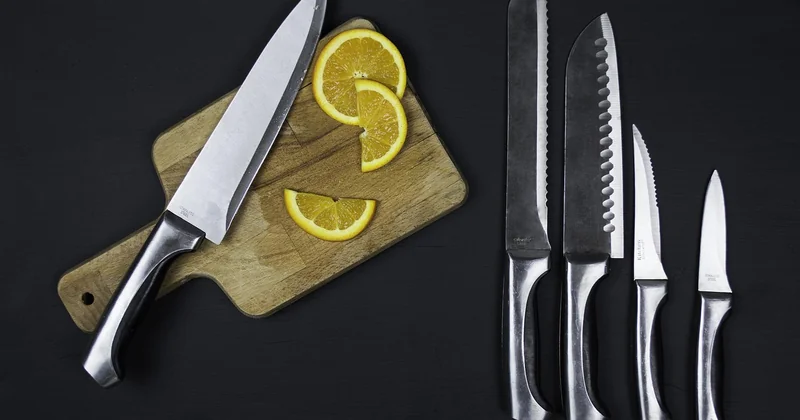
- Chef's knife (20–25 cm): the workhorse. If you buy one knife, buy this.
- Paring knife: small tasks, in-hand work, peeling.
- Serrated bread knife: bread, tomatoes, anything with a tough skin and soft interior.
- Utility knife: the awkward middle size, useful for sandwiches and small prep.
- Boning knife: flexible and thin, for working around bones.
- Slicing or carving knife: long and narrow, for roasts and large proteins.
- Santoku: a Japanese-style alternative to the chef's knife, not an addition to it.
Note the last one carefully. A santoku and a chef's knife do the same job. Owning both is fine if you enjoy them, but it isn't "essential" in any meaningful sense.
What knives should every home chef have?
Three: a chef's knife, a paring knife, and a serrated knife. That set handles essentially everything a home kitchen produces, from dicing an onion to slicing a loaf to peeling a pear.
The fourth, if you want one, is a second chef's knife in a different length—a shorter one for smaller hands or tighter board space. Beyond that, buy as you find a genuine gap, not because a list told you to.
My mistake was buying a full block set in my first year of cooking seriously. It cost more than a single good chef's knife and half of it has never touched a vegetable. Buy one excellent knife, learn it properly, then expand.
What actually slows most home cooks down
It's rarely the technique. Here's what I see most often, including in my own early years:
- A dull knife. The most common problem, and the most invisible, because you adapt your grip and pressure without noticing.
- Gripping the handle. Shifts the pivot point to your wrist and makes the rocking motion clumsy.
- Cutting on the wrong surface. Glass and stone boards dull an edge fast. Wood or a good plastic board is kinder to the blade.
- Working on an unstable board. As above: towel underneath, always.
- Cutting pieces of wildly different sizes. They cook at different rates, so half your vegetables are soft and half are raw.
- Rushing. Speed is what you earn after consistency, never before it.
Fix the first four and everything else improves on its own. Most of what looks like a technique problem is actually a setup problem.
A realistic order of learning
Start with the pinch grip and the claw, and give them a full week of normal cooking before you judge them. Then rough chop and slice, which are forgiving. Then dice, which demands even spacing. Julienne and chiffonade last—they're refinements, not foundations.
How long does it take? My honest estimate from my own experience: a few weeks to feel competent with the grip and the rock chop, a couple of months before dicing feels natural, and longer for the fine cuts. That's cooking dinner, not drilling.
Which brings up something worth sitting with. The point of good knife skills isn't speed or restaurant-style precision. It's that prep stops being the part of cooking you dread. Once your hands know what to do, dinner gets quieter—less wrestling, fewer uneven pieces, less time standing at the counter while the pan waits.
So: pick up one onion tonight, hold the blade at the bolster, tuck your fingers into a claw, and cut slowly. Nothing else needs to change.